In this article

Corporate governance is entering one of its most demanding eras. As boards head into 2026, they face a convergence of rising risk, regulatory pressure, geopolitical uncertainty and accelerated technological change, all of which are reshaping what effective oversight requires. Expectations are higher, scrutiny is sharper, and the pace of decision-making has never been faster.
The most effective boards are shifting from passive oversight to active, data-driven governance, where disciplined human judgment works alongside artificial intelligence (AI) to enhance strategic decision-making and risk management.
Despite this rapid transformation, significant gaps remain: while governance technology adoption accelerates, many organizations still struggle with fragmented systems and manual processes that slow down decision making.
What do boards need to know about how corporate governance will evolve in 2026 and beyond? Here, we will unpack:
The world has changed significantly in the past year. These trends reveal how internal and external forces will fundamentally reshape corporate operations and what boards need to know to stay ahead.
Board technology has evolved far beyond simple board portals to become AI-enhanced governance platforms that change how directors prepare for meetings, assess risks and make strategic decisions.
Leading boards pair AI insights with disciplined human judgment, measure real usage of AI tools rather than just survey sentiment and pilot “lighthouse” projects to prove tangible value before scaling. AI literacy, bias testing and human-in-the-loop oversight ensure responsible adoption, while stepwise integration enables measurable improvements in board efficiency and strategic decision-making.
The gap between adoption and governance readiness is the defining challenge: Boards are using AI faster than they are building the policies and expertise to oversee it.
Automate and summarize every board meeting for faster decisions and stronger compliance oversight.

Financial fraud can plague even the most outwardly successful organizations. In 2026, the challenge is building a corporate culture that roots out bad actors. This is easier said than done, given that corporate culture isn’t always effective at promoting transparency.
Boards should embrace culture oversight as a strategic asset. In addition to traditional compliance metrics, they can leverage anonymized data streams, such as intranet messages or chat trends, to identify early warning signals of misconduct or ethical concerns. A strong speak-up culture, with closed-loop reporting and board visibility, enables boards to detect fraud or ethical lapses early and respond swiftly, guided by pre-defined escalation protocols for the first 72 hours following a crisis.
While boards traditionally held senior leaders at arm’s length, integrating leadership with board directors can advance the processes, talents and best practices that compliance depends on. This ethical culture also has tangible benefits for the bottom line. LRN’s research shows that organizations with strong ethics outperform others by up to 40% across key metrics.
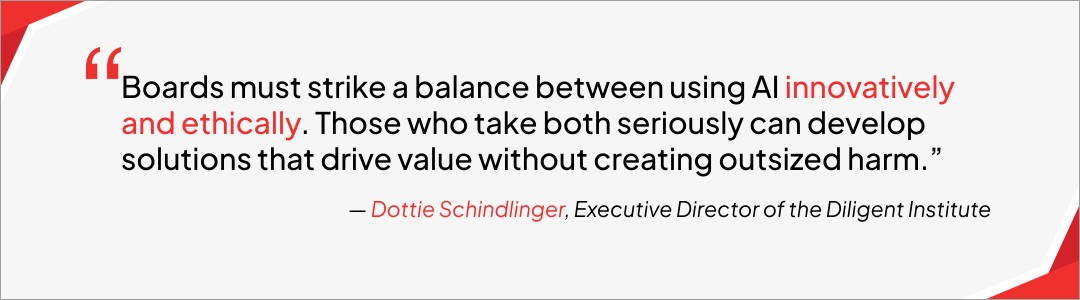
AI deployment introduces ethical considerations that require rigorous oversight. Boards should implement a robust ethical framework from the outset, systematically testing for bias and privacy concerns and ensuring human judgment remains central. Ethical oversight should tie directly to measurable adoption metrics, linking technology usage to culture and risk management outcomes.
Ethics aren’t just about regulations either. AI brings numerous well-documented risks, including unintended bias and invasions of privacy. Harvard Business Review details several questions corporate AI strategies must answer, including:
Cybercrime is the biggest risk most organizations will face in 2026. The ever-increasing value of data largely fuels this threat.
Generative AI has increased organizations' attack surface by an estimated 67%, and the cost of breaches is projected to rise from $9.22 trillion in 2024 to $13.82 trillion by 2028.
What Directors Think 2026 ranks cyber breaches as the third-biggest organizational risk, behind a sharp U.S. economic downturn and black swan events. Directors also rate cybersecurity as the biggest "underrated risk" of 2026, suggesting boards are not giving it the attention the threat warrants.
The pressure is just as acute in the Asia-Pacific region, where 46% of respondents prioritize managing cyber risk in 2026 and 65% name digital transformation as their most urgent board discussion topic.
Over the next year, boards must remain vigilant. Infrastructure and data upgrades of all sizes must be considered high-risk. Implement software and configuration changes carefully and strategically to avoid widespread disruption or damaging breaches.
Take CrowdStrike, for example. This U.S. cybersecurity company deployed a faulty CrowdStrike Falcon software update in July 2024 that triggered an outage affecting roughly 8.5 million computers using Microsoft systems worldwide. The insurance costs are still mounting but are expected to reach $300 million to $1 billion, costs that could have been twice as high, if the outage had been malicious. More robust change management and a strategic approach could have mitigated this far-reaching crisis.
The quarterly board meeting model is being disrupted by real-time governance capabilities that enable continuous oversight and more agile decision-making.
Unified dashboards that consolidate risk data, performance metrics and compliance status into real-time views are replacing the quarterly board meeting as the default oversight model. Yet only 23% of boards currently make moderate use of AI-powered dashboards for risk oversight, despite directors ranking enhanced AI-powered technology third among strategies to improve board oversight.
"Boards are going to have to be a bit more fluid and flexible. Dashboards are really the only way forward." — Dottie Schindlinger, Executive Director, Diligent Institute
Continuous visibility into risk and performance data lets boards identify emerging issues between meetings, track progress on strategic initiatives and respond to market shifts without waiting for the next quarterly cycle.
Gain unmatched clarity on risks, streamline meetings.

The workplace will transform over the coming years. 58% of the global workforce will be Millennials or younger by 2030, many of whom were hired during the pandemic and have primarily worked remotely. Job hopping — switching jobs frequently — has also emerged as a break from traditional corporate culture.
“They’ve never been in an office. They don’t know what corporate culture looked like pre-pandemic because they’re not a part of that history,” says Schindlinger.
As a result, talent, risk and culture have dominated the board agenda. Businesses are grappling with significant demographic shifts as baby boomers near retirement and new generations take their place. Additionally, board and C-suite succession may become challenging as experienced board directors near retirement without qualified younger talent to replace them.
Companies should start nurturing young talent by considering which tools and structures can facilitate innovation and mentoring; many organizations are renaming committees to highlight “talent” and “culture.” This includes thinking about job hopping differently.
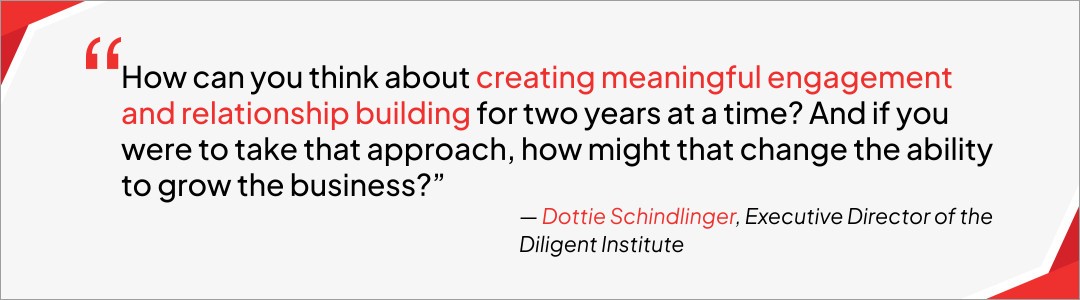
Boards must also think beyond tradition and consider whether hybrid work models that appeal to young talent can bolster the productivity their organizations need.
“Boards should be asking: What do we need to do differently? What are the tools we have in place to keep everyone connected? How do we keep the board connected?” says Schindlinger.
Looking ahead, secure messaging tools can keep the board connected and engaged in strategic conversations about talent between meetings. Using these tools advances conversations about nurturing young talent rather than waiting for board meetings.
Despite growing emphasis on board effectiveness, significant gaps remain in evaluation practices. Leading organizations are achieving measurable improvements through comprehensive evaluation frameworks, while many boards struggle with assessment processes that fail to drive meaningful change.
While many directors remain confident in their board’s ability to self-assess, the 2025 PwC Annual Corporate Directors Survey reveals a sharp increase in peer-review pressure: 55% of directors now say at least one fellow board member should be replaced, indicating widespread concern that current evaluation practices are failing to drive meaningful change.
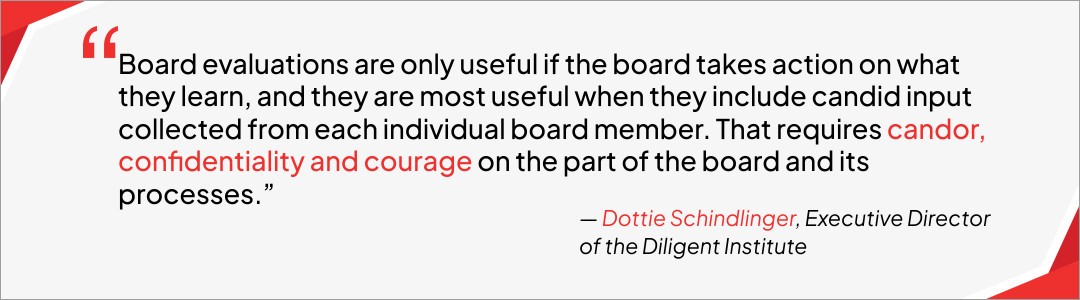
To take this corporate governance trend seriously, boards must commit to thorough, confidential evaluations that foster honest dialogue and translate insights into tangible actions. This requires full participation from every member and a commitment to implement changes based on the evaluation findings.
The seven trends above capture what is changing inside the boardroom. But boards do not operate in isolation. Political shifts, regulatory costs, shareholder pressure and calls for board renewal are creating external forces that shape how effectively organizations can respond to the governance challenges already on their agendas.
Many view the UN's 2004 Who Cares Wins report as the document that made environmental, social and governance (ESG) mainstream. While ESG principles remain important, the political scene has significantly complicated implementation and strategic positioning.
Politicians on both sides of the aisle have different opinions on ESG and, as a result, different ideas about what constitutes good governance. The 2024 U.S. presidential election only underscores the worldwide shift to the right, opening the door to changes in ESG policy and governance more broadly.
“A political party comes in and sweeps away what was existing, a trend seen over the past decade, especially in the U.S. This makes the job of corporate boards increasingly difficult," says Schindlinger.
Now, boards will likely have to chart their paths forward individually, toeing the line between complying with the SEC, other regulatory bodies and the Trump administration while meeting the expectations of their shareholders and customers.
Political winds in the U.S. are shifting, which might upend existing focus on sustainability in the States. However, most other major economies in the world are increasingly focused on climate change.
In the post-universal proxy era, shareholders continue to hold boards accountable in new ways. Governance proposals increased for the first time in recent years during the 2024 proxy season, as did compensation proposals. Support for say-on-pay proposals also remained high, and unions submitted more proposals in 2024 than they did in years prior following recent high-profile strikes.
These dynamics are carrying into the 2026 proxy season, where anti-ESG proposals continue to rise even as shareholder support for them stays low. Companies submitted no-action requests in connection with 43% of proposals from anti-ESG proponents, compared to 25% for others, a pattern boards should expect to persist.
Boards can prepare by aligning closely with shareholder expectations and offering transparency around decision-making on the issues investors care about most.
Regulatory compliance is a growing challenge for mid-market companies facing disproportionate cost burdens. American businesses spend approximately $300 billion annually on regulatory compliance, but these costs are distributed unevenly across company sizes.
The challenge goes beyond cost for enterprise organizations. Managing compliance across multiple jurisdictions, business units and regulatory frameworks simultaneously creates exponential complexity. According to the Transaction Readiness Report by Diligent Institute, Wilson Sonsini, NetSuite, CFO Alliance and CFO Leadership Council, only 4% of governance leaders globally say their GRC and financial systems are fully integrated for transactions.
Ninety-seven percent of organizations report facing at least one major challenge in being transaction-ready. Overlapping requirements from dozens of agencies across international markets create administrative overhead that can overwhelm even well-resourced compliance teams.
According to PwC’s 2025 Annual Corporate Directors Survey, 55% of directors believe at least one board colleague should be replaced, the highest proportion recorded in the survey’s history. This reflects growing recognition of underperformance, skill gaps and the need for more rigorous oversight. Boards are under pressure from stakeholders, including shareholders, to ensure that board composition, oversight practices and decision‑making structures are fit for purpose.
For many organizations, this will translate into board refreshment, enhanced oversight of executive compensation and performance with greater transparency in how CEOs are held accountable for governance, strategy execution and results.
Now, shareholders will want to see CEOs performing, specifically making what shareholders see as the “right” decision to maximize returns. At the same time, rising inflation and supply chain issues have renewed the call for corporations and their CEOs to act ethically and responsibly.
Growth strategies are also a top priority. Pursuing growth through M&A and strategic partnerships is listed as the top organizational priority for 2026 and ranks third on board agenda items, according to the 2026 What Directors Think report.
The trends and external factors above are largely shaped by domestic governance dynamics. But boards with international operations face an additional layer of complexity: Regulatory frameworks, geopolitical risks and economic pressures vary sharply by region, and each demands its own governance response.
Global AI regulations are fragmenting quickly, with different regions pursuing distinct approaches that create complex compliance challenges for multinational organizations. The EU AI Act is the most comprehensive current framework, with fines up to €35 million or 7% of worldwide turnover, and staged obligations now entering enforcement.
This regulatory fragmentation creates challenges for enterprise organizations operating across multiple jurisdictions. Companies must navigate varying requirements for AI governance, risk assessment and transparency while maintaining operational efficiency.
The Russia–Ukraine conflict continues to strain Europe’s economy via energy shocks and higher security, refugee and energy‑independence spending, reinforcing the need for continuous monitoring. These geopolitical dynamics create complex risk assessment challenges that require continuous monitoring and strategic adaptation.
Top risks for GCs now include changes in the regulatory environment, tariffs/trade, geopolitical conflicts, inflation, workforce management and technology adoption/implementation. Overall risk levels for GCs have risen from 5.8/10 to 7.9/10 in Q1–Q3 of this year, and 84% of boards have changed their scenario planning approach in the last five years due to heightened risk, according to the 2026 What Directors Think report from the Diligent Institute.
For organizations with global operations, supply chain governance has become a critical board-level concern. In fact, CEOs now identify supply chain issues as a top business risk, reflecting increasing complexity and vulnerability of global networks.
Different regions face distinct economic pressures that influence governance practices. Health crises continue to challenge Africa's economic growth, while emigration and political instability shape Latin America's business landscape. China's economic posture influences operations throughout the Indo-Pacific region, forcing boards with regional exposure to factor shifting trade relationships into their planning.
These regional variations require risk assessment processes and governance frameworks that adapt to local conditions
The Trump administration's trade policies are creating immediate governance challenges for multinational corporations. While tariffs on China have been temporarily paused, the administration has implemented sweeping tariff increases on other trading partners, with threats of additional measures that could reshape global supply chains.
These policy shifts require governance frameworks capable of scenario planning and rapid strategic adaptation. The interconnected nature of global commerce means that U.S. trade policy changes cascade through supply chains and affect organizations worldwide, forcing boards to prepare for multiple potential scenarios simultaneously.
Winning organizations now treat professional governance platforms as core to board performance — converting administrative work into speed, clarity and trust. Traditional methods can’t keep pace with expanding regulation and rising expectations; modern platforms must streamline prep, strengthen risk oversight and elevate decision quality.
The most effective platforms deliver measurable impact across three areas: intelligent document management to accelerate board preparation, advanced risk detection to flag issues before distribution with strategic intelligence that prepares directors with personalized insight.
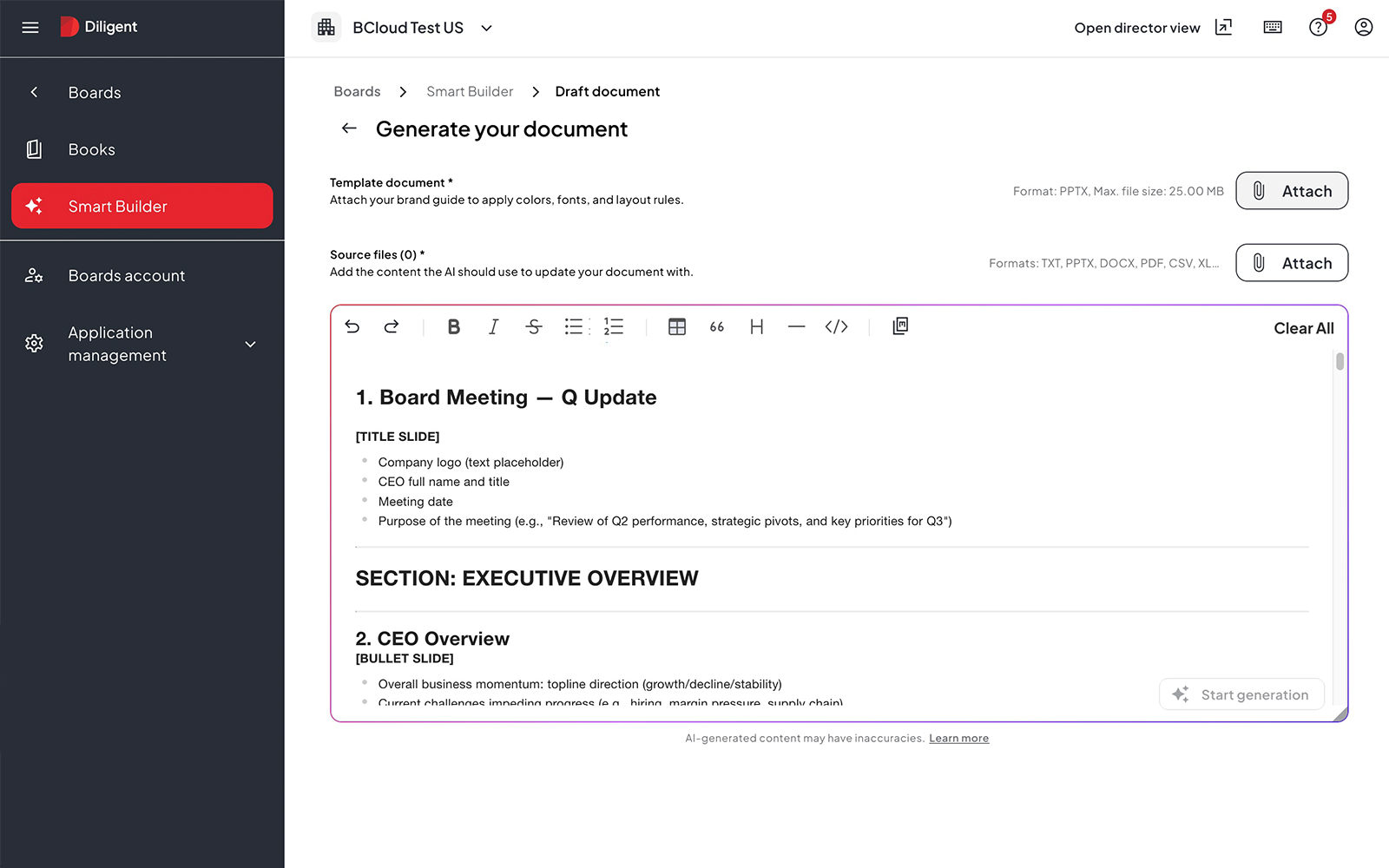
Today’s board platforms like Diligent Boards pair a best‑in‑class portal with GovernAI to radically reduce prep time and improve quality: AI‑powered board book summaries, automated minutes and action‑item capture, plus personalized preparation tuned to each director’s committees, expertise and history.
Add the newest workflow accelerators:
What’s new in practice:
Boards need continuous, contextual monitoring — not just manual reviews. Smart Risk Scanner brings AI‑assisted, policy‑aware scanning into board materials to flag legal, compliance and operational risks before distribution, aligned to industry standards and governance best practices; it’s now live for all GovernAI customers.
Compliance workloads are rising: 82% of GCs expect greater use of technology (including AI) for monitoring and regulatory tracking next year; 73% expect more emphasis on internal audits and compliance monitoring; and 77% anticipate higher emphasis on policy reviews.
What good looks like:
High‑performing boards arrive prepared with targeted insight. SmartPrep 360 and Smart Book Summary analyze current materials and history to surface personalized insights and strategic questions for each director, backed by automated summaries and cross‑document correlation that reveals connections a manual read may miss.
Add live context and faster inputs:
Why this matters now
With integrations, best‑practice templates and AI assistance, professional governance infrastructure moves boards from retrospective reporting to forward‑looking oversight — helping leaders act at the speed of business while managing risk and regulatory demands
Make 2026 your most effective year with Diligent Boards. Cut prep time, strengthen oversight and elevate decision-making with features like Diligent Data Room, Smart Builder and more.
Schedule your 20‑minute product tour to see it in action.
The leading trends include AI-powered governance platforms, cybersecurity as a board-level oversight priority, corporate culture and ethics accountability, board effectiveness and refreshment, real-time governance dashboards and workforce talent strategy. On the external front, ESG recalibration, shareholder activism, rising regulatory compliance costs and geopolitical uncertainty are reshaping board agendas. Boards that build adaptive governance frameworks around these themes can act on risk and opportunity faster.
AI is changing governance in two distinct ways. First, boards are adopting AI-powered platforms that automate board preparation, risk scanning and meeting effectiveness. Second, boards must govern AI as a business risk, establishing ethical frameworks, usage policies and compliance processes for organizational AI use. According to What Directors Think 2026, 66% of directors now use AI for board work, but only 22% have governance processes in place to guide that usage.
The EU AI Act is the most significant new regulatory framework, with fines up to €35 million or 7% of worldwide turnover and staged obligations now entering enforcement. Trade policy volatility, the ongoing Russia-Ukraine conflict and shifting tariff regimes are forcing boards to strengthen scenario planning and supply chain oversight. According to What Directors Think 2026, 84% of boards have changed their scenario-planning approach in the past five years due to heightened risk.
PwC's 2025 Annual Corporate Directors Survey found 55% of directors say at least one colleague should be replaced, the highest level in the survey's history. Boards should prioritize recruiting directors with digital, AI and cybersecurity expertise, treat evaluations as continuous improvement tools rather than compliance exercises and maintain active CEO succession pipelines. Growth through M&A and strategic partnerships is the top organizational priority for 2026 according to What Directors Think 2026, making leadership continuity critical to execution.
Boards need AI-powered governance platforms that automate board book creation, scan materials for legal and compliance risks before distribution and provide personalized preparation content for each director. Real-time dashboards that consolidate risk data, performance metrics and compliance status enable continuous oversight between quarterly meetings. Only 23% of boards currently make moderate use of AI-powered dashboards for risk oversight, despite directors ranking enhanced AI-powered technology among the top strategies to improve board oversight.
Discover how Diligent Boards transforms governance from a quarterly exercise into a continuous capability. Schedule your 20-minute product tour to see Smart Builder, Smart Risk Scanner and SmartPrep 360 in action.